
Process Pending: learning to see
"the relation between what we see and what we know is never settled"

I’ve been trying to learn to draw, which it turns out is actually learning to see and perform what I see. Where and why does the light hit? What actually are edges? What does it mean for my hand to follow my eye? To do this, I have been doing exercises and watching short videos but mostly I have just been drawing more frequently. Not every day but many days.
I am actually pretty bad1 at drawing, so there is not usually much of an immediate reward at the end of practice. I look at what I’ve done and it looks bad, e.g., it shows its effort with little in the way of results (emotion, realism, fluidity, structure, conceptual interest, etc), and the lines are too firm, and the proportions are awkward, and the image is very stiff. It takes a very long time for me to draw even small things. It is a real effort.2
Trying to learn to draw, I have realised that despite a well-honed, natural-to-me seeming athletic proprioception, when drawing, my hands and eyes are childishly uncoordinated. My blind contour drawings show an extreme disjunction between beginnings, middles, ends, proportions, circles, outlines, ridgelines. Trying to learn to draw has made me realize how little I see. Habitualized, I skim the world like I might skim a dense text when I’m tired3: without even realizing4.
As part of this effort to learn to see, I finally read John Berger’s Ways of Seeing. Based on Berger’s 1970s BBC series, Ways of Seeing explores the ways oil painting, photography, and graphic design are connected in a lineage of seeing central to Western worldbuilding.
“The way we see things is affected by what we know or believe… when an image is presented as a work of art, the way people look at it is affected by a whole series of learnt assumptions… Many of these assumptions no longer accord with the world as-it-is… Out of true with the present, these assumptions obscure the past… History always constitutes the relation between a present and its past… the past is not for living in; it is a well of conclusions from which we act.”
John Berger, Ways of Seeing, pp 8,11
I have owned this book for years… like at least 8… but never read it all the way through because Ways of Seeing is a really weirdly designed book. The font is tiny and bold, the margins uneven, the paragraph indents gigantic and awkward. It is really strange. I have never seen anything published quite like it (except old school zines?). I’ve seen a lot of commentary on the contents of the book itself but none (I can find) on its design. This is one of the pages:
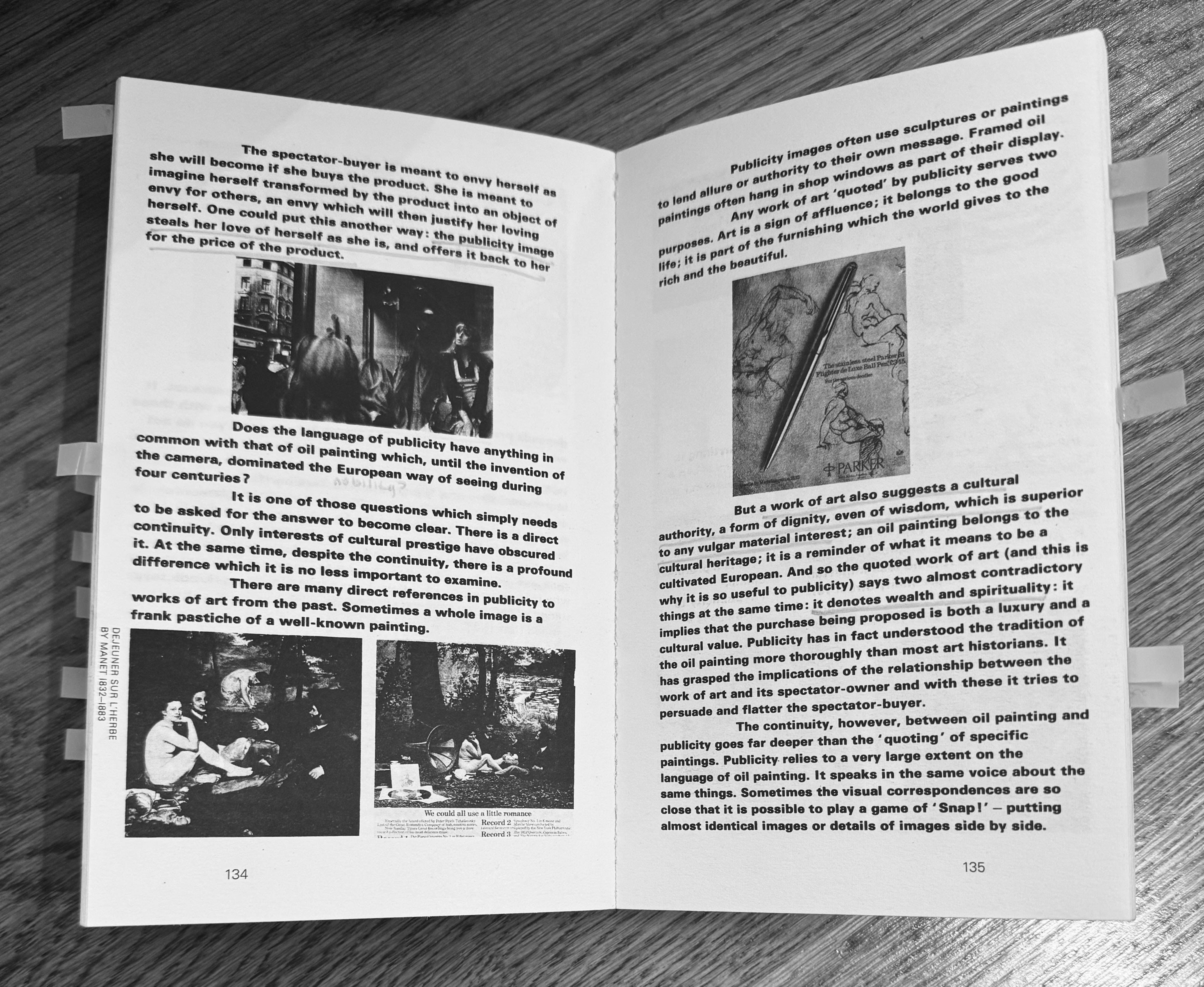
The way the book is designed is jarring. I think it was made this way on purpose. It is designed (perhaps) to be intentionally out of step with how a text “should” be and this makes you think about about the text as an object, emphasizing it as one of many arguments/tools/methods for understanding/seeing. Through its physicality, it makes you aware you are reading a point of view with a specific design, i.e., intention. It is literally a book about close-looking, or at least thinking about close-looking, and yet you can’t even really see the images or paintings; the resolution is draft photocopy-bad. There’s just no way John didn’t do this on purpose. The book, in other words, is performative.
Performativity is variously defined by philosophers as something like “words that are actions instead of descriptions”, though it has been construed lately(?) to mean “doing something without purity of intention”.5
In her book Meeting the Universe Halfway, Karen Barad reclaims performativity as an embodied way of knowing, challenging the dominance of textual representation/discourse over matter6:
A performative understanding of discursive practices challenges the representationalist belief in the power of words to represent preexisting things. Unlike representationalism, which positions us above or outside the world we allegedly merely reflect on, a performative account insists on understanding thinking, observing, and theorizing as practices of engagement with, and as part of, the world in which we have our being.
Karen Barad, Meeting the Universe Halfway, p.134
Ways of Seeing is a materially performative book7. The way the book is designed is asking you to see that seeing is shaped by context, form, and historicity and in this effort intentionally subverts the legacy it posits, like who is acknowledged and centered and how. Nested in the book are small tokens, rewarding attention. John Berger’s name is on the front but on the first inside page immediately refutes this:
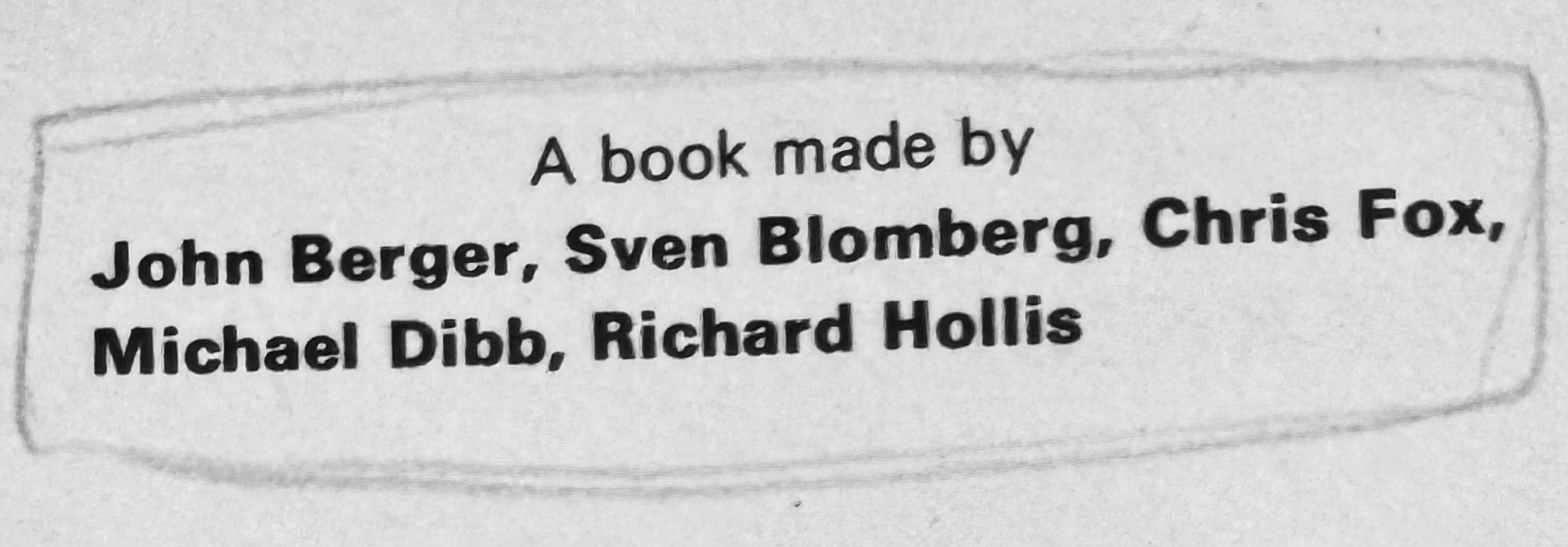
At other times, the essays explicitly acknowledges that in-text citations were removed from images because they were visually disruptive, which is an aesthetic choice that shapes an argument (the paintings are all cited in the back). The unusual design knocks you off kilter, which, as you are righting yourself, makes you are aware of the effort you have to exert in order see and comprehend.8
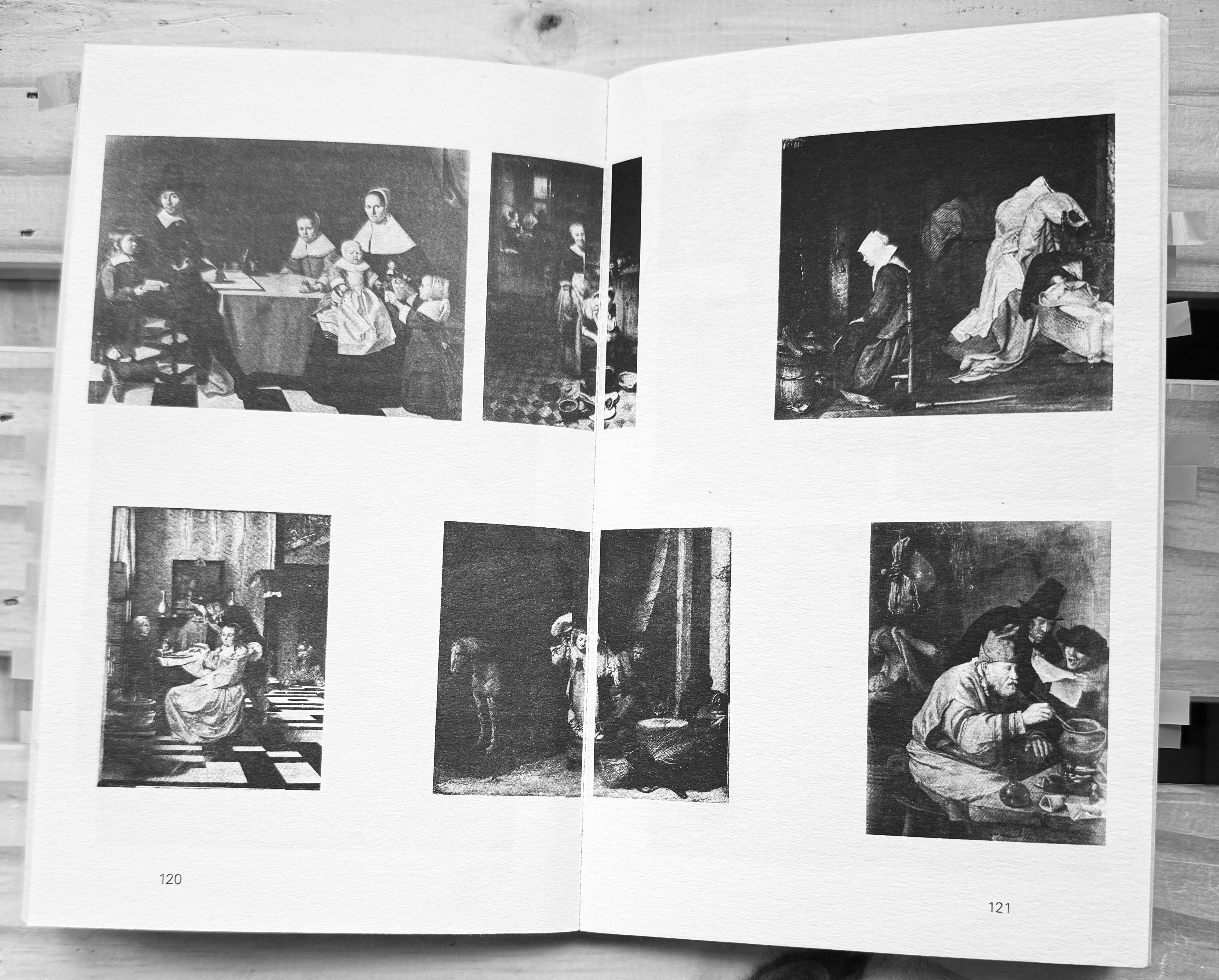
In Ways of Seeing, the knowledge is embodied. The format of the book---proportions, font, margins, text style, resolution---embodies the message. You cannot just read the essays, the essay is given in a form and the form itself is meaning, is metaphor. There is a (free) website with the whole contents of the book with much better reproductions of the images, but since it lacks a distinctive friction (and also lacks a lot of Berger’s emphases and has some typos), the book, in the end, offers tremendously more. The friction offered by the design supplies the heat necessary for metamorphosis, that is, the understanding that thrithe9 the content and the form and the context of the form and content matter. Berger, and Bloomerg and Fox and Dibb and Hollis, demonstrate and explicate and that is how, at the end of it, we readers, lookers, seers, holders, humans, come to an understanding.
Embodied knowledge is one of the main appeals of drawing for me. The great thing about drawing is that if you do it at all you get better, i.e., you learn to see and interpret the world and/or your mind. Drawing is performative. Drawing in public, tracing a photograph, following a video and trying to mimic the movements of the instructor, doing exercises, figuring out how to move your hand and body and eye together are all tactics for learning. What makes it authentic? The effort? And if you don’t try or don’t try to draw well, jokes on you, you’re still drawing.
Another example of a book where the structure is the message (and the subject is drawing) is Lynda Barry’s Syllabus, one of my absolute favorite books/manifestos out there on teaching, thinking, artscience integration, creativity, attention, constructing community, and deconstructing preconceived ways of doing and seeing.
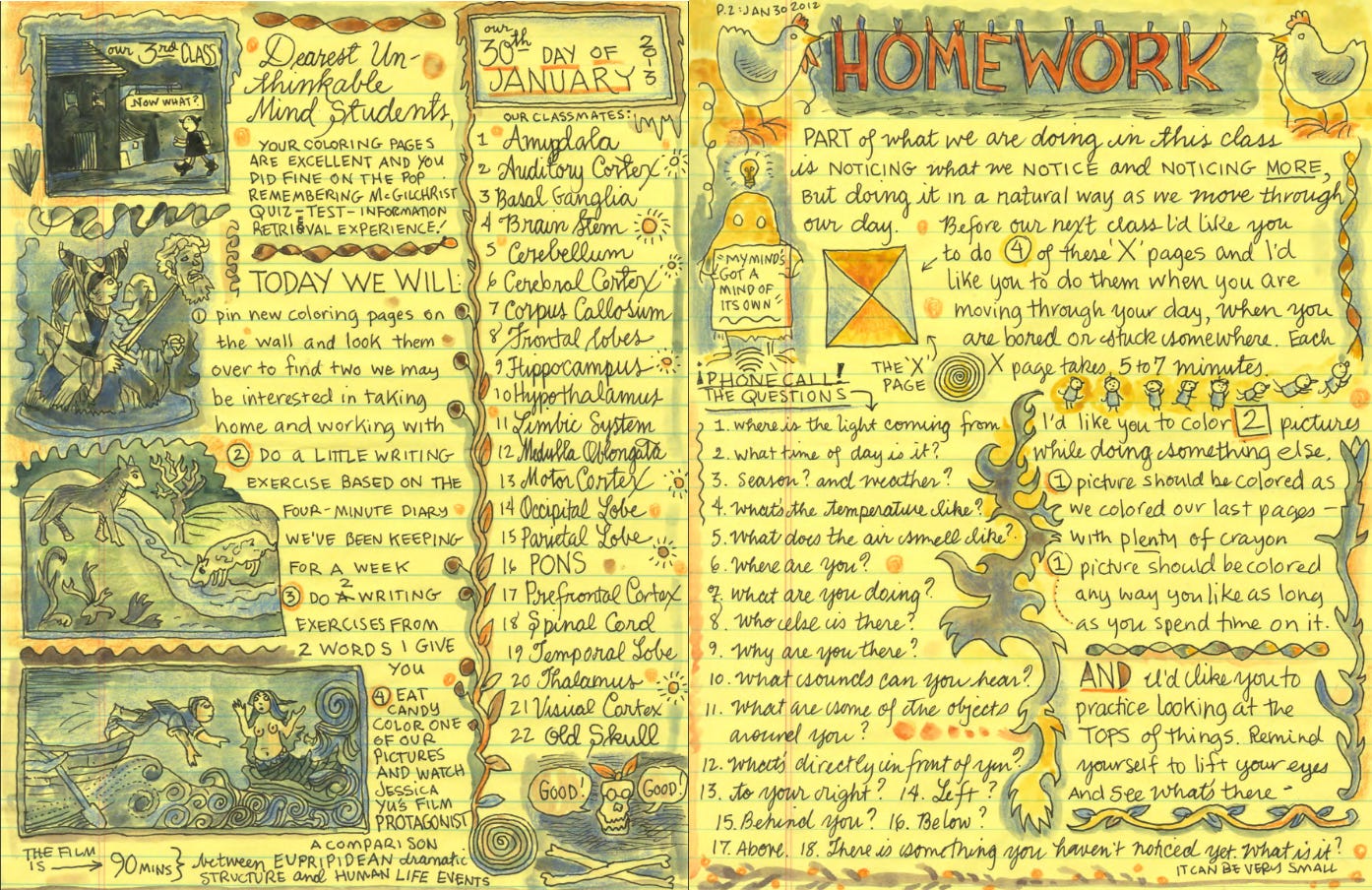
In Barry’s class, called The Unthinkable Mind, the students take on a identity (i.e. skull, amygdala) for the semester which gives them an anonymized identity separate from their “bad-or-good-at-(drawing)” selves. They color printouts with crayons, memorize and perform poems, fill composition notebooks with X pages, draw monsters, close read their memories, and pay attention to the impact their work has on their material worlds, e.g. which of their pencils has been used the most. In other words, in order to get around the stigma of “not knowing how to draw”, but also to show the (neuroscientifically validated) power of the transformation of a state of mind, Barry has her students perform many roles: that of a child, that of a poet, that of a brain, that of a monk, that of an artist. Wikipedia sums it up well: “Performance is a bodily practice that produces meaning”.
So I will perform lines and color and texture again and again and again and again and look and see and meaning might emerge.
Other than to keep drawing, my ethos for 2026 is pretty straightforward: slow to completion, instead of fast to abandonment. The thing I struggle with most often is the last 10%. The other thing I struggle with is commitment. The other other thing I struggle with is trusting that I know/knowing what I want. This is par for the course of being human. And while I like Eileen Anh’s argument that maybe ideas don’t need a vessel and are instead held by community10, and indeed have practiced this, I come back to the argument she makes earlier in the same essay:
An idea falls short without a vessel to hold it. An idea incepts through a medium, the medium is held by a repository, the repository, known and acknowledged.
Eileen Anh, Demand for Tangibiilty
Coming off months of writing grants, proposals, and job applications—in other words, articulating what I might do, thinking about doing and doing nothing—I’ve exhausted my explicating brain. My ideas poured out into the world lie flat on the page. This year’s the year to build them the vessel, to find them a form and context and content to hold them and make them meaning.
My reading in the last month was really idiosyncratic. I read two Henry James novellas (Washington Square and Daisy Miller) because I love Renee Gladman and in November spent many hours driving from New York to Vermont to Maine listening to various interviews with her. She loves Henry James, and she (among many) talks about James’ sentences as architectures. Anyways I think I need to keep trying, neither of these landed. I did appreciate the analysis of Washington Square as being James’ most play-like book: it was an attempt to write a novel like a play. This helped me understand the limited setting and character suite and somewhat stilted(?) conversation.
I received and read Gladman’s novella TOAF (To After That) as a gift and it helped me start writing again. TOAF is a eulogy, summary, process of putting to bed a piece of writing (art) that never congealed, that lost its chance. Her prose is so simple and honed, and she is exceptionally good at describing process and intention:
“My challenge was to build, out of a series of empty spaces, a cohesive narrative long enough to be called a novella, but not so long nor so cohesive that it suffered from chronology, a thought that led me to this somewhat unfinished query…”
Renee Gladman, TOAF, p. 42
And there are little gifts in the text, like when she quotes her own fictional character (from a different work) as an authoritative source and then laughs at herself while never falling into self-deprication:
Luswage Amini, the great Ravickian novelist, once conferred to an interviewer: the first novel will be given to you from the remains of some other’s long lost project. Despite how this sounds—to my ears a bit foreboding and overwrought—I was not afraid of the inheritance.
Renee Gladman, TOAF, p. 12
I listened to Agatha Christie’s The Mysterious Affair at Styles while stripping and re-caulking our shower. Fun, an excellent twist, superior plotting except right toward the end. It was slightly racist and antisemetic but in a way that felt true to English aristocracy the time even if it might have also been Christie’s views?
I read my first Olga Tokarczuk, House of Day House of Night, supposedly her most autobiographical and her most difficult. Exceptionally descriptive with gorgeous prose. There were parts that were absolutely transportive, and parts that really felt difficult to keep moving through. I could not quite find the thread, or perhaps there was none, as life has none. I did like it a lot, but I’m not sure how to recommend it. There was this:
Because it is hard to find (used) books in English in the Netherlands, I order a lot when I’m back in the States to bring home. Here is my haul this time:
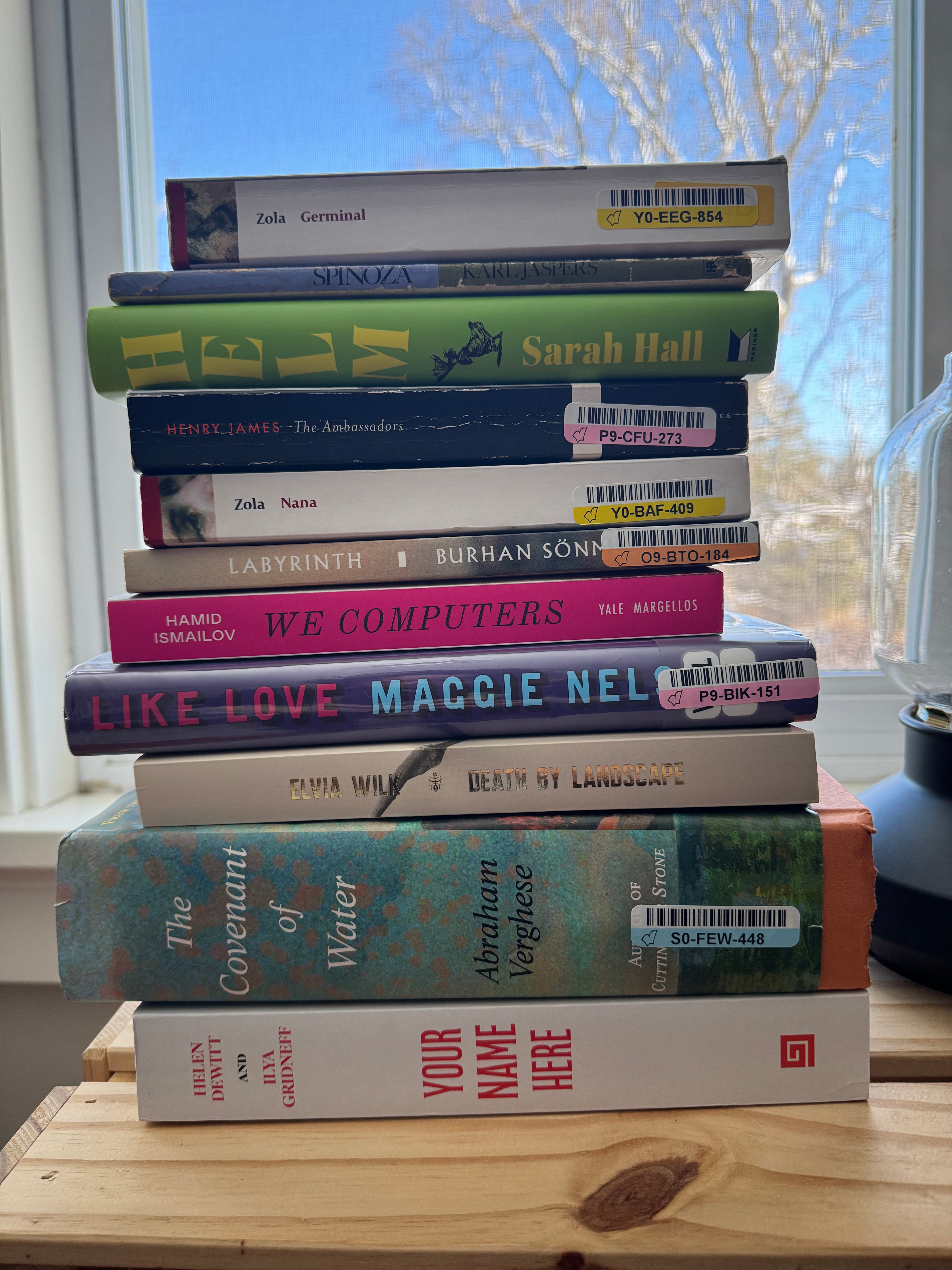
Happy 2026!
Cheers,
Elizabeth
i know, i know, i am not not “bad”, just new or untrained or early in the process but i feel okay about saying, honestly, my drawings are not good. i am not skilled at this.
Here’s where I might include some drawings, but honestly I am embarrassed? or not embarrassed but i’m okay with not “showing the process”? and also don’t want you, mystical reader, to compare what you do or judge it, like no need for an “actually that’s good!” or “wow if they think they’re bad i’m worse!”
or an easy text, if i was only just learning to read, to make this comparison really literal
I have some ideas about why drawing is so full of effort for me, namely that my brain is basically empty of images (literally, a big dark space) though it is rich with letters and sound: text, music, voices
Performativity is in in 2026, having been re-adopted as an act of earnestness. While writing this piece, Celine Nguyen came out with a great discussion of performativity when it comes to reading in her most recent newsletter, Writing is an inherently dignified activity
matter as in physical things, like an electron or a chair, just what exists around that’s not idea or speech or discourse or dream,
I read Helen DeWitt’s The Last Samurai in September and am reading Your Name Here and these are somewhat-examples of the content requiring a specific form and in fact the reason she hasn’t published more: that publishers resist anything whose form is not standardized. (I pound my fist, while writing on Substack).
And this is exactly what drawing does for me
as in both but for three, lol, i’ll die on this hill
“But what if ideas were enough? What if we, as people, were enough to hold our ideas as art? I know this sounds nice in theory — I am especially restless when it comes to creating. But more recently, I’ve been thinking about how my friends are my most immediate vessels... And what is art if not just seeds of curious conversations and wondrous explorations in community? Or if not just a series of words and strings of thoughts woven together to serendipitously birth new ideas, to then somehow find a home that may or may not be tangible? Most of my thoughts currently do not hold tangibility.” Eileen Anh, Demand for Tangiblity, March 2024
I was very obsessed with Portrait of a Lady as a teenager, and I'm tempted to recommend it. I learned how to diagram sentences while reading it, in part to understand how in the world his incredibly long, yet sensible, ones were constructed. Perhaps I should re-read.